
LIFE AS A WOMAN IN STEM: A TALK WITH THE BEE BABETTE

Happy International Women’s Month from Planet Bee! As a proudly female-led organization, we deeply understand the importance of women in science; especially considering that women are still underrepresented in STEM careers. Anybody can be a scientist, and we are dedicated to creating equitable access to environmental learning and literacy regardless of race, gender, income or geography.

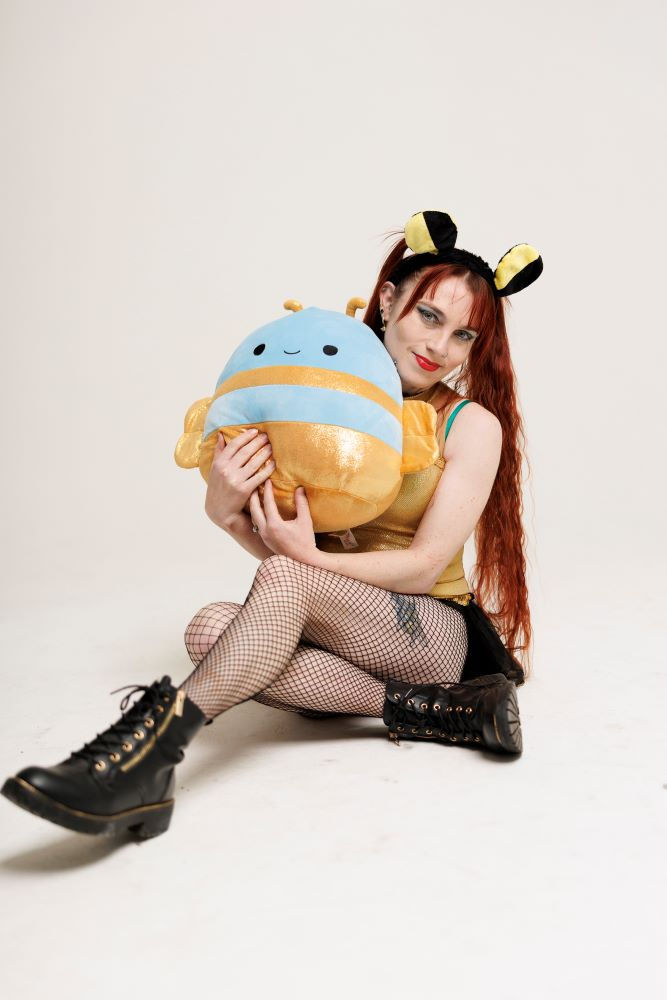
To celebrate this year’s International Women’s Month, we spoke with Dr. Kit Prendergast, a valued member of the Planet Bee community as well as a native bee ecologist and performing artist who performs as a science communicator under the persona the "Bee Babette”. She gained her PhD researching native bees in Australia, and has gone on to author over 80 peer-reviewed publications and receive awards for her work as a scientist and artist. During our interview Dr. Kit was able to share with us her experiences as a woman in conservation, how to support others in the field, and the significance of her work in science communication and native bee research.
As a woman in the highly specialized field of native bee research, what have been the most significant shifts you’ve seen regarding gender equity since you began your career?
I began my career as a native bee scientist in 2016. Nine years later I don't think a whole lot has changed in some aspects. I do think there has been increasing recognition that women are clearly just as capable as men in scientific research, and there's more acknowledgement and even requirements for women to be on boards, or have leading roles. However, major barriers include a system that favours men, especially men without families. For example, you're expected and rewarded to move from university to university across countries after you complete your PhD. This is a massive burden for a woman with a young family. Many conferences and workplaces don't have allowances or grants to bring families, or daycare or breastfeeding rooms.
There's also expectations that women should look certain ways - almost like you should hide your femininity. For example, wearing make-up which would be considered standard in some jobs e.g. as an air hostess (flight attendant), would be considered over-the-top in many scientific circles. So there remain quite restrictive stereotypes about what a scientist should look, act and live like.
How has your identity as a female scientist influenced the way you approach conservation and fieldwork?
Women tend to score higher than men in empathy and compassion especially when it comes to non-human animals, and I definitely meet this tendency. Conservation isn't a job, it's something I live and breathe. I care deeply about the natural world. Now as a mother to a little girl, I want to protect nature and the beautiful biodiversity our planet hosts so that she can inherit such a world. Whether it's a stereotype or a biological reality is unclear, but females are often portrayed as 'emotional' — I certainly am, but that is in NO way a bad thing. We need people to be passionate in conservation. We can't be passive and cold. Emotional doesn't mean any less scientific, or any less objective. It means that I care, deeply, when science is ignored. To protect the natural world and native bees that are at risk of extinction, we need the best available science.

We need to advocate, love and celebrate nature and wild bees. When people beewash or destroy nature, this is something I cannot just brush off. I want to show that being 'emotional' is not a weakness, it's a strength. When it comes to fieldwork, I thrive! Fieldwork is often stereotyped as more of a male occupation, but I love going out in the wilderness and am not afraid but have a respectful relationship with all the 'dangerous' animals — bees, wasps, snakes, spiders. There are extra considerations as a woman doing fieldwork. You just have to be that extra bit cautious when you're out by yourself, not of animals, but of men! You also have to shrug off social norms and acknowledge you're going to have to do bush pees!
You have a unique ability to connect with non-scientists globally. Why is it a priority for you to engage specifically with women and girls who may not have a science background?
Science is essential for understanding the world, our place in it, where we came from, how we are related, and how we can protect this beautiful planet and our fellow creatures. Denying children a good education is a crime. Scientific knowledge is empowering, and if we shut off women and girls to science, we are doing them a terrible disservice, and also hindering the advancement of science. You don't have to dumb science down, it's about packaging it in an engaging and interesting way – this is what makes science accessible to all.
What does "connecting across the globe" look like for you in 2026, and how do you use digital platforms to foster a sense of community among women in STEM?
We are both more connected than before with the internet at our fingertips… but also less connected. AI and bots are rife, people don't even write with their own voice, it's something spat out by AI. I use digital platforms with my own voice, making it real, and sharing real messages of connection, engagement and inspiration to women.
One way everyone can help support women across the globe is to like their content, follow them, share their posts, share their stories, and share their research. It costs nothing, and means a lot to women who want to make a difference. In a world where those who have the largest voice are those who work the algorithm, not those who actually speak with authenticity, authority, experience and qualifications on a topic, go and support the latter.
What are the most pressing research / trends affecting native bees you are currently seeing in bee conservation research that the public should be aware of?
The most pressing research and trends in bee conservation the public need to be aware of include three things. First, taxonomy: there are hundreds of species that are undescribed - if they aren't described, we can't monitor, study or place them in the tree of life. Then there are many genera that don't have keys - this makes it very hard to identify species. Species identification is so important, and AI cannot do this. We desperately need to fund, support, train and celebrate taxonomists more.
In relation to this, communicating about species. There is a lack of taxonomic education among the public, and this hinders science communication, and species conservation. Too often scientific names aren't even mentioned. This can lead to miscommunication, obscures diversity, leads to misunderstandings, is very anglocentric, and ignores evolutionary relationships. It also reduces scientific literacy and contributes to the lack of awareness and respect for taxonomy — the science of identifying, describing and classifying biological diversity.
Finally, the impact of honey bees on native bees: more and more scientific publications are coming out showing the honey bees can harm native bees through resource competition; through being promoted over native bees e.g. honey bees are supergeneralists and often forage on a wide array of exotic plants, so planting such an array of flowers can exclude specialist native bees; and through disease transmission. Despite honey bees being at no risk of extinction, and being an introduced species in many parts of the globe, they still get the lion's share of media, public and funding attention. If we want to save bee biodiversity from extinction we need to shift the focus.
Why is it vital to intentionally expose girls and underrepresented individuals to STEM opportunities? How does a diverse workforce change the actual outcomes of conservation science?

There is absolutely no inherent reason why girls should be any less capable of science, but historically they have been barred from it, and today there are still barriers to women in science including non-family friendly workplaces and cultures, and restrictive stereotypes about what 'types' of girls and women can do science. We can see throughout history women have made vital and incredible contributions to science. If we exclude certain demographics from science, we are excluding certain individuals who may make major contributions to our understanding to protect and understand the planet.
In your show “The Birds & the Bees”, you are able to turn the topic of pollination into an entertaining show through your witty comedy and aerial performances. What is the value of reframing scientific topics in a way approachable to the general public?
The science and arts have often been seen as completely separate - this notion is damaging to both. We need science to understand the world and art to make us think, care and act upon these understandings, because facts alone often won't make people act. Science and scientists are often portrayed as serious, dry, dull, and without creativity. This show tears down these stereotypes and shows the public that science is fun, flirty, exciting and entertaining, without losing the complexity and factual accuracy. The show encourages the public to realize women in science are not a monolithic type. It also encourages people to realize how vital pollinators are for all aspects of our lives - even our love lives!

You’ve said that native bees are still under-researched. What would be the impact of investing more into understanding our native bee populations?
There is still so much we have yet to discover about native bees, especially their life-history, and in Australia it is estimated there are around 500 undescribed species. There is no science-based ongoing monitoring program of native bees in Australia, meaning we can't accurately track how populations are doing. We also need to monitor how interventions such as flower strips or integrated pest management impact native bees. Here, farmers have to pay a non-scientific charity to be told how to boost bees (with a focus on honey bees), and then there's no monitoring to see if this actually pays off. In other parts of the world there are subsidy schemes to encourage farmers to adopt wild bee friendly practices, and monitoring to create tailored advice.
There also needs to be way more investment and research into non-agricultural contexts. There's this obsession with pollination but the fact is, especially in Australia, most crop pollination is by honey bees. The bees that need helping the most don't pollinate crops, they specialize on wildflowers that may even conflict with boosting crop pollination. We need to better understand the nesting substrates of many native bees. Just over 60% of Australian bees nest in the ground (compared with an estimated 70% of species globally) but the substrate preferences of different species is poorly known, as well as how we can better manage soils to encourage nesting. We also need a better understanding and inclusion in native bees in pesticide and chemical assessments. Risk assessments are based on the European honey bee which can be a poor representative for bees as a whole regarding both toxicity and exposure to chemicals. We also need to better understand how to manage fire regimes for native bee biodiversity, and also optimize greening strategies in urban areas to support native bees. Another topic is how to help native bees adapt to ongoing climate change.
Finally, we need to better understand how to ensure beekeeping is done in a way that is sustainable. I'm putting together, without any current funding, an Australian Native Bee and Pollinator Conservation Strategy which highlights and sets an actionable evidence-based course of action to address these big gaps. Overall, the impact of investing more in understanding native bee populations is that we can be armed with the evidence and science to protect, conserve and promote actions to prevent declines and extinctions of indigenous bee biodiversity.
Thank you to Dr. Kit for sitting down with us and reflecting on her lived experience as a woman in STEM, as well as giving us insights into her projects and research! It’s amazing to see someone so passionate carve out her own space for native bee conservation and to share that passion with others. Women deserve a place in the sciences just as much as anyone else, and we must keep working and advocating to make it a space that’s equitable for all people.
Support our Mission
If you want to help Planet Bee lower barriers to STEM and create equitable access to environmental education, consider supporting our Environmental STEM programs! With your donations we can provide our programs to schools at zero cost, centering around environmental awareness, leadership using scientific and engineering knowledge, and care for the environment.


